
OptOSS AI v.10.1 - Release
OptOSS AI v10.1 introduces new powerful AI-driven capabilities for cybersecurity operations, root cause analysis, monitoring, and operational efficiency.
.png)
OPT/NET
June 1, 2026
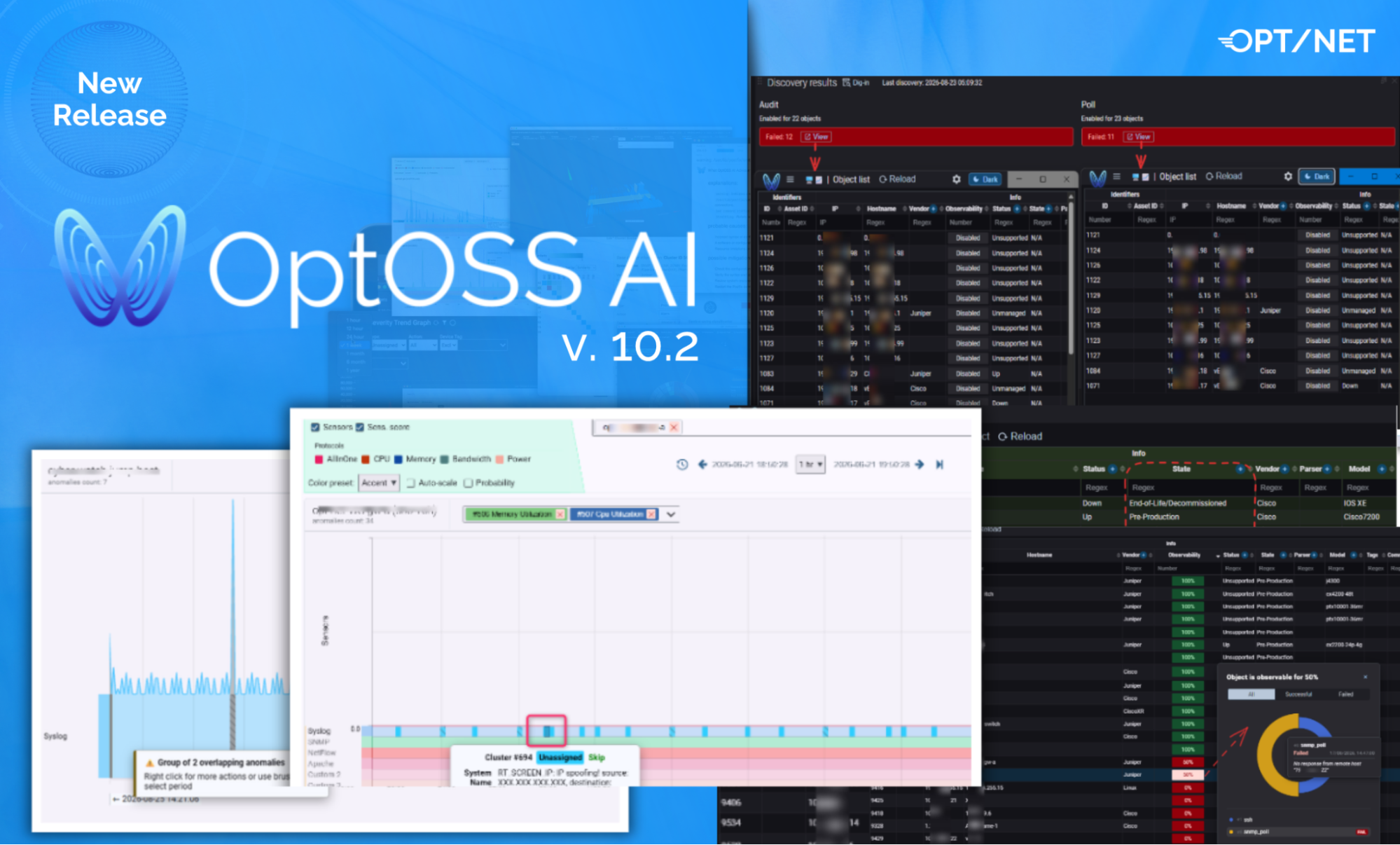
We are excited to announce the release v10.2 of OptOSS AI®! This version introduces telemetry channel reliability tracking, ITIL device lifecycle states, enhanced operational visibility, tightened audit and security controls, and UI/usability improvements for large-scale ICT systems.
To make accurate decisions, OptOSS AI must reliably receive telemetry data. OptOSS AI v10.2 introduces a new feature that automatically measures telemetry channel reliability and suggests which communication channels should be inspected.
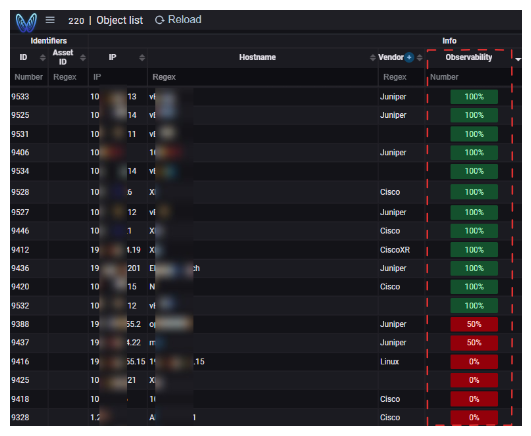
Every device is attached to a monitoring profile that defines all telemetry protocols expected to populate OptOSS AI with data. OptOSS AI periodically checks the reliability of each protocol and calculates an aggregate observability score. This score is displayed in the Object List view, using clear color-coding to distinguish between fully operational devices and those requiring attention:
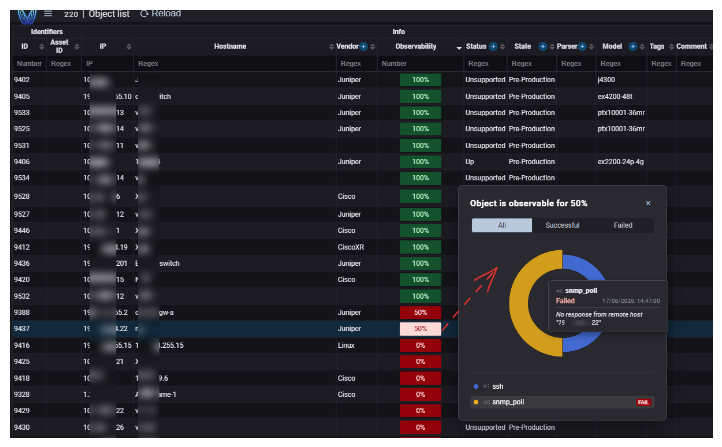
Clicking the device score opens a window showing the current reliability of every telemetry channel attached to that device.
A new feature in OptOSS AI v10.2 enables system administrators to assign a lifecycle state to each device, aligning with industry standards and best practices such as ITIL frameworks or custom, company-defined asset states.
Every device added to OptOSS AI is assigned a default state of 'Pre-production,' which system administrators can manually update as needed. OptOSS AI checks device states during periodic audits. If it detects a device which should be in the 'End-Of-Life/Decommissioned' state that is still online and responsive, it automatically alerts operators and sets the status to 'Pre-production' for further inspection.
The device state is displayed in the Object List View under the 'State' column and supports regular expressions (regex) for filtering.
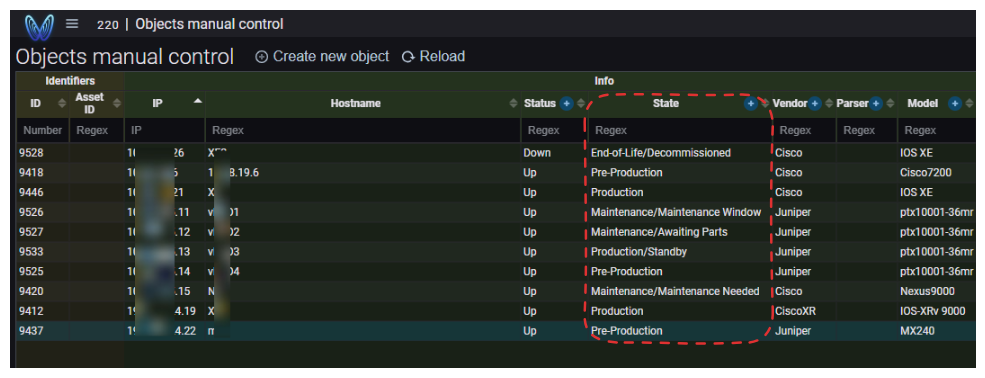
A fresh installation of OptOSS AI comes with a pre-loaded set of states that can be easily customised to fit environment requirements without affecting functionality.
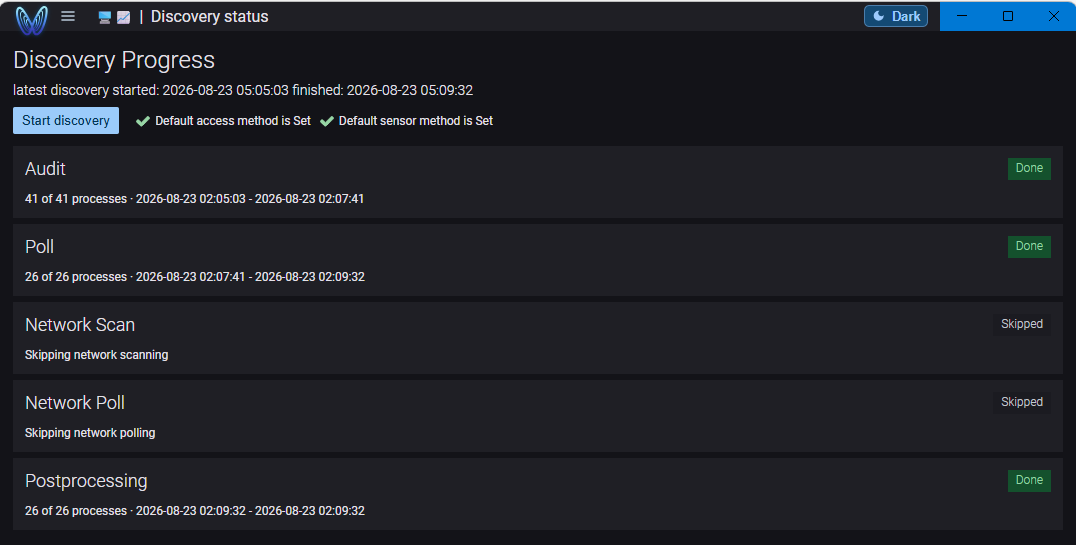
The Discovery Status window has been enhanced to clearly display key milestones during network wide discovery operations:
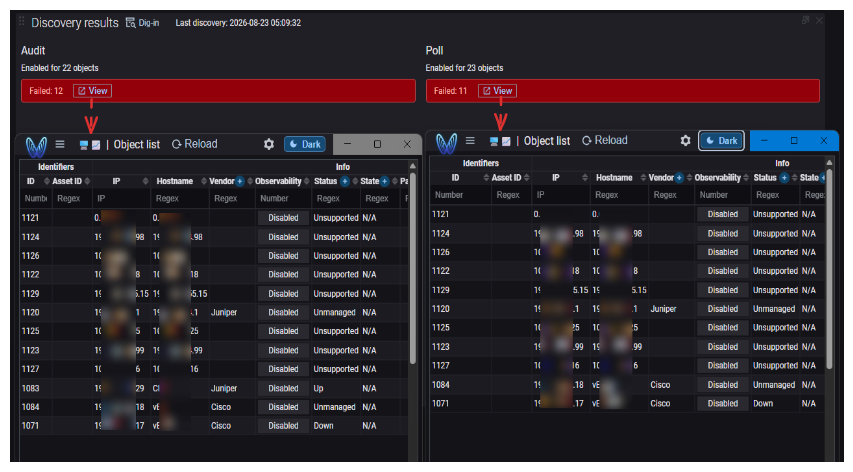
OptOSS AI v10.2 introduces a new widget that visualises discovery results, displaying the number of devices with active auditing and polling actions, alongside those where either process operation failed to deliver the expected results. Clicking 'View' opens the Object List View filtered to show all such failed operations for devices in the specific category.
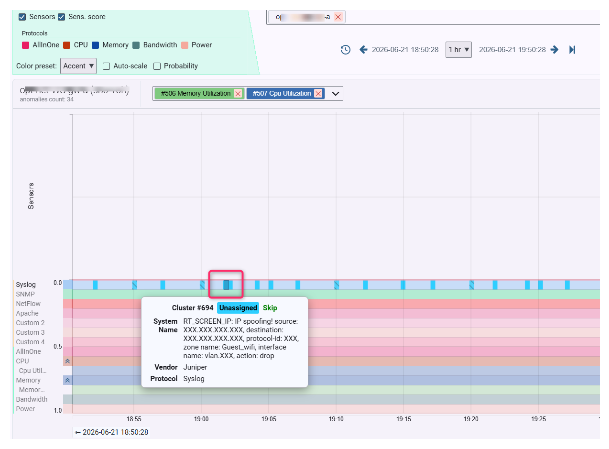
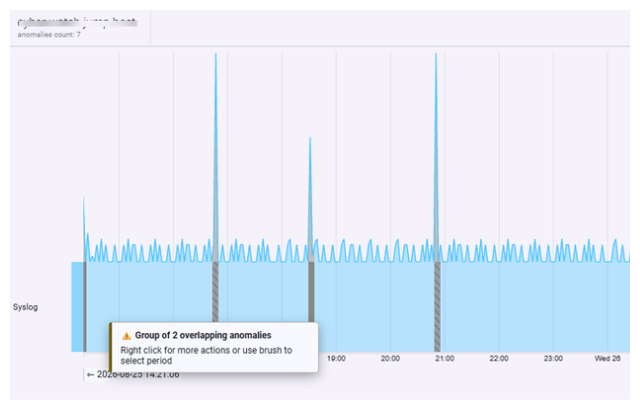
OptOSS AI v10.2 introduces graphical enhancements to the History View, clearly separating two anomalies that occur on the same device close together in time.
When an interface is initially discovered on a device and the discovery process successfully establishes a remote access session over it, the interface is marked as management-capable. During periodic network polling or auditing, if the primary assigned interface is unresponsive for any reason, the system attempts to establish a remote session using one of these previously identified management-capable interfaces.
Once access is established, the process verifies that the session belongs to the intended device. If the device hostname matches the name in the OptOSS AI inventory database, it proceeds with the standard poll or audit. If a hostname mismatch occurs and the newly discovered hostname is not already in the database, OptOSS AI adds it as a new device. This logic optimises periodic audits by reducing failed attempts caused by flapping on a single management interface.
In addition to the features listed above, this release includes numerous stability improvements, performance optimisations, and issue corrections across the platform.
To find out more, please, contact us at info@opt-net.eu or fill in the contact form at: Get demo
.png)


