
OptOSS AI v.10.2 - Release
OptOSS AI v10.2 is now available! The latest release brings new capabilities for network observability, device lifecycle management, discovery visibility, and operational resilience.
.png)
OPT/NET
September 1, 2026
.png)
The Network Operations Center (NOC) serves as the operational backbone of telecom networks responsible for real-time monitoring, fault detection, and incident response. But as networks evolve in scale and complexity, the NOC must evolve too.
In the 1980s and 1990s, NOCs were designed around static infrastructure: hardware-based networks, predictable traffic, and manual operations. By the early 2000s, the introduction of centralised dashboards and rule-based automation began to streamline workflows. However, these were still limited to reactive incident handling. Between 2010 and 2016, many Tier-1 telecom operators made progress toward modernising their NOCs with rule-based alarm correlation, event filtering, and centralised dashboards. These enhancements aimed to cope with skyrocketing telemetry from increasingly complex, hybrid networks.
As 4G rollouts matured and early SDN/NFV adoption took hold, it became increasingly clear: manual alarm handling and threshold-based systems were no longer sustainable. The industry began looking toward AI, ML, and intent-based operations as the next leap forward, setting the stage for the emergence of the Cognitive NOC.
For decades, NOC operations were defined by a simple, reactive workflow:
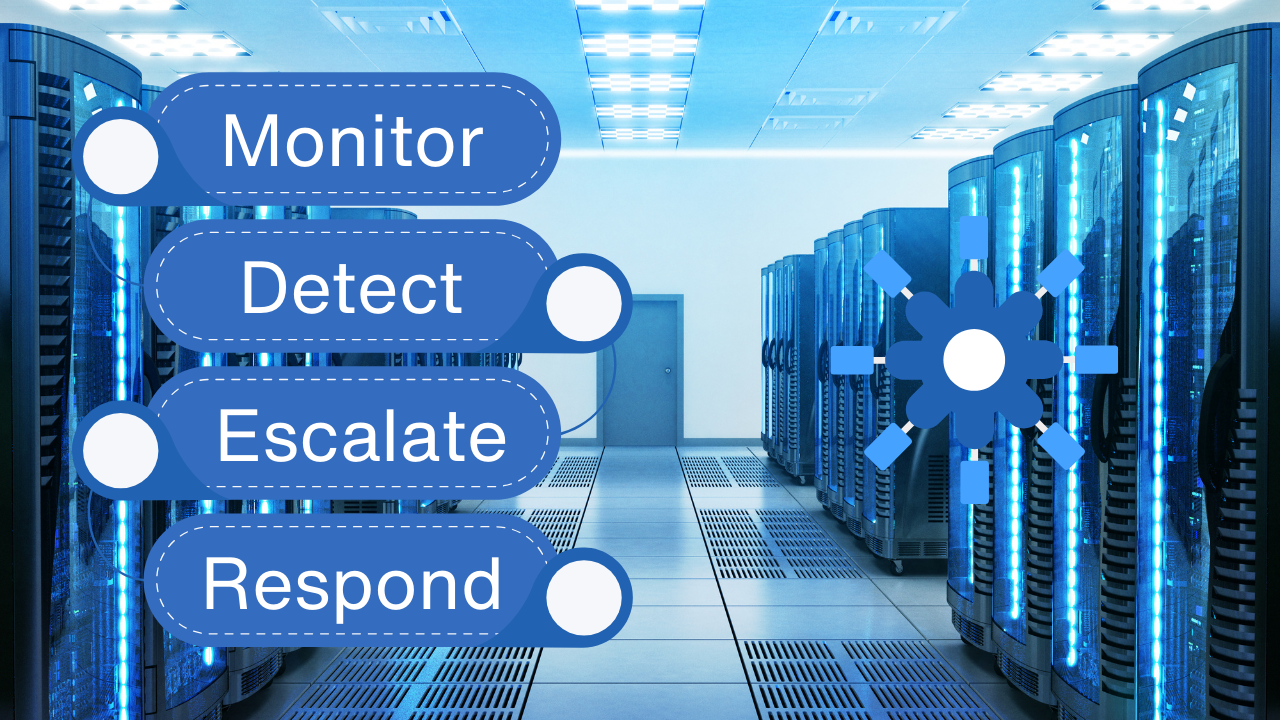
Telemetry flowed in, alarms triggered at hard thresholds, and human operators analysed, triaged, and escalated incidents manually. While some tools aggregated alerts, the core intelligence remained human based on tribal knowledge and experience.
As networks grew more complex in the 2010s, this model began to break down. Multi-vendor architectures, mobile backhaul, virtualisation, and early SDN deployments introduced layers of interdependencies that traditional alarm systems couldn’t see. The same fault could trigger thousands of redundant alarms across layers and domains creating what the industry called “alarm storms.” These floods of alerts overwhelmed operators and buried the truly critical signals.
.png)
As the TM Forum’s Orchestration: Get Ready for the Platform Revolution report highlighted, networks were already growing rapidly in complexity. Operators faced an intricate mix of physical and virtualised infrastructure, legacy systems, and emerging technologies. This increase strained traditional NOCs, which still relied heavily on manual processes, legacy tools, and rule-based alarm correlation. These approaches struggled to handle the massive volume and speed of modern network data, leading to fragmented workflows, low automation, higher costs, and slower incident resolution (TM Forum, 2016).
Ericsson researchers described telecom NOCs as handling billions of service alarms, approximately 20 million workflow notifications, and millions of service desk emails — all of which contributed to significant operational burden. The heavy workload forced operators to focus largely on triaging and classifying alarms, leaving limited capacity for proactive root-cause analysis or process improvements (Ericsson, 2018).
Despite efforts to consolidate OSS platforms and follow ITIL frameworks, traditional NOCs struggled with a lack of contextual awareness. Alerts rarely indicated service impact, and correlation across domains remained limited. Many root-cause diagnoses depended on tribal knowledge rather than automated analysis, making scalability and agility difficult. These trends left operators stuck in firefighting mode, lacking the tools to prioritise by service impact or prevent future incidents.
The traditional NOC reactive/manual approach, designed for an era of relatively static and hardware-centric networks, can no longer meet today’s demands — where cloud-native architectures, real-time SLAs, and millions of events per hour have become the norm.
The telecom industry's shift toward software-defined infrastructure, cloud-native services, and real-time SLAs has outpaced the capabilities of traditional NOC models. Enter the Cognitive NOC (cNOC): A next-generation operational paradigm that fuses Network Operations, Service Assurance, and AI/ML into a single intelligent control hub. Unlike legacy NOCs, which react to events, a cNOC is designed to understand, predict, and act in real time, at scale.
At its core, a Cognitive NOC transforms the way telecoms manage network events and service quality. It leverages AI/ML and automation not to replace human operators, but to enhance their ability to act on signals that matter.
.png)
Traditional NOC workflows often begin when something breaks. A cognitive NOC inverts this model by focusing on early detection, proactive prevention, and adaptive response. Rather than surfacing thousands of raw alarms, it delivers a handful of correlated insights, often enriched with root-cause hypotheses and automated response options.
The Cognitive NOC is defined not just by the integration of AI and automation, but by its ability to reason across heterogeneous datasets and act with contextual awareness. One of its core capabilities is intelligent event correlation, the capacity to associate alarms and telemetry across layers, domains, and vendors to isolate the root cause. While legacy systems often rely on static rules, cognitive platforms learn from dynamic topologies and shifting service configurations. With traditional NOCs, up to 90% of alarms remain uncorrelated or redundant, overwhelming staff with noise and delaying accurate diagnosis. By contrast, cognitive NOCs use adaptive, reasoning‑driven architectures to correlate data across layers, domains, and vendors, dramatically reducing alarm storm volume and improving root‑cause isolation accuracy.
Unsupervised anomaly detection further strengthens the Cognitive NOC, identifying never-before-seen patterns that fall outside established norms. In networks where devices can produce 100K+ telemetry events daily, anomaly detection helps prioritise real incidents and prevent false positives. Advanced anomaly detection and CX monitoring allow operators to detect potential faults early (often before customers notice) and optimise remediation and ticket assignment workflows. McKinsey reports that, when applied at scale, these capabilities can reduce troubleshooting volumes by 30–70%, lower network operations center costs by 55–80%, and accelerate mean time to repair (MTTR) by 30–40%, while also delivering measurable improvements in customer experience.
By surfacing issues earlier in the operational lifecycle and automating prioritisation and resolution steps, the Cognitive NOC shifts operators from reactive to proactive service assurance, driving more efficient operations, greater reliability, and improved customer satisfaction.
Predictive analytics and maintenance are also one of the fundamental elements of cognitive NOCs. Instead of waiting for outages, these systems analyse historical trends and real‑time signals to anticipate degradation or failure. In predictive maintenance, AI can forecast network equipment issues with up to 92% accuracy, cutting unscheduled downtime by half. This capability is projected to drive the predictive maintenance market in CSP networks to $4.1 billion by 2027 (Verified Market Reports).
AI‑based load balancing is another critical capability in cognitive NOCs. By predicting and dynamically redistributing traffic loads, AI‑driven load balancing improves efficiency by up to 27% in high‑density networks. Telecoms employing predictive load distribution report 33% fewer service outages, and the adoption of AI solutions in load balancing is growing at 20% annually (Verified Market Reports). This proactive approach not only enhances network performance but also reduces the risk of congestion‑related incidents.
Another feature is topology-aware reasoning, the system's understanding of how network resources, services, and customer segments interconnect. Topology awareness provides context. This allows cognitive systems to assess the real-time business impact of incidents.. Cognitive automation also extends to closed-loop orchestration. Closed-loop automation turns detection into resolution. Instead of static runbooks or manual scripts, the system autonomously triggers actions like VNF restarts, service rerouting, or ticket creation — continuously learning and adapting over time.
Importantly, the human role is not removed, but transformed. Engineers evolve into AI supervisors: fine-tuning models, validating automation decisions, and focusing on edge cases that require domain expertise. This partnership between human intelligence and ML enables the NOC to scale with network complexity, while retaining visibility and control. In the cNOC, operators are no longer buried in alarms or locked into repetitive triage.
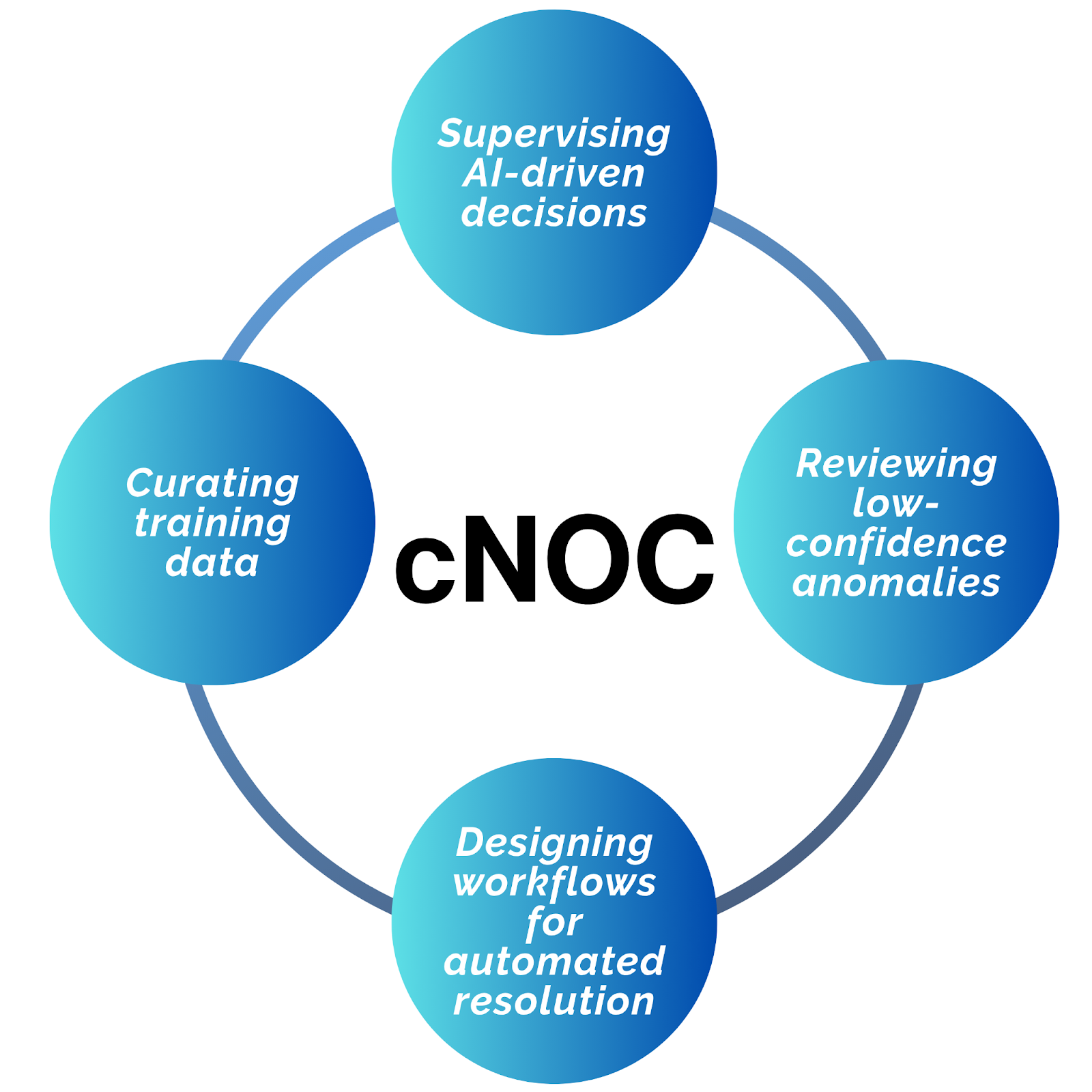
This human-in-the-loop model is not just about oversight, it’s about continuous improvement. Operators help train the system, validate actions, and refine models, enabling the NOC to evolve from reactive support to proactive assurance.
Many operators are already achieving step-change improvements in visibility, accuracy, and response speed through cognitive operations. While full autonomy (a so-called “Dark NOC”, where AI systems handle detection, triage, and resolution without human oversight) remains aspirational, it is increasingly seen as the natural extension of the Cognitive NOC. In a Dark NOC, intelligent agents not only analyse vast telemetry streams and correlate multi-vendor alarms in real time but also orchestrate and execute corrective actions autonomously, closing the loop without waiting for human input. Although such fully autonomous operations are not yet mainstream, the industry is clearly moving in that direction. Already, cognitive capabilities are being deployed that enable proactive anomaly detection, intelligent event correlation, and partial automation of incident response, laying the essential groundwork. As confidence grows and systems mature, Cognitive NOC and Dark NOC are no longer a distant vision, it is a roadmap milestone.
Moving from a traditional NOC to a Cognitive NOC is not a matter of switching on a new tool, it is a strategic evolution. The goal is to shift operations from reactive firefighting to proactive, context-aware assurance. The first step is identifying domains where AI can deliver measurable results quickly, while also laying a scalable foundation for long-term autonomy.
For most operators, the alarm flood remains the most urgent challenge. A Tier-1 telecom may process 20–30 million alarms daily, yet only 1–5% are actionable. Low correlation rates and high redundancy directly prolong MTTR and inflate operational costs. This is where AI-powered event correlation makes the greatest impact: clustering redundant alarms, suppressing noise, and surfacing root causes to reduce alert noise by more than 90%. Instead of drowning in raw notifications, NOC teams are left with a manageable stream of actionable insights and faster root-cause analysis.
Once correlation cuts through the noise, automation becomes the next step. Context-aware playbooks, triggered by anomaly detection and topology-aware reasoning, can handle recurring faults automatically. At scale, such automation can resolve hundreds of incidents daily, cutting MTTR and freeing engineers to focus on complex, high-value cases.
Unsupervised anomaly detection extends this capability further, surfacing never-before-seen patterns that static rules cannot anticipate. AI-based anomaly detection helps operators to deal with massive volumes of telemetry and address service-impacting issues earlier, sometimes reducing incident rates by over a third. When combined with correlation and automation, anomaly detection transforms raw telemetry into actionable intelligence.
But technology alone is insufficient. Achieving the full benefit of a Cognitive NOC requires a parallel evolution in organizational processes. Telecom operators must move away from rigid, reactive workflows and establish dedicated, proactive incident handling procedures. This means designing new workflows where AI-generated insights (like predicted failures or detected anomalies) automatically trigger preventative actions, rather than waiting for a confirmed service outage before initiating a response. The shift is not just about tools; it's about embedding intelligence into every layer of operational decision-making.
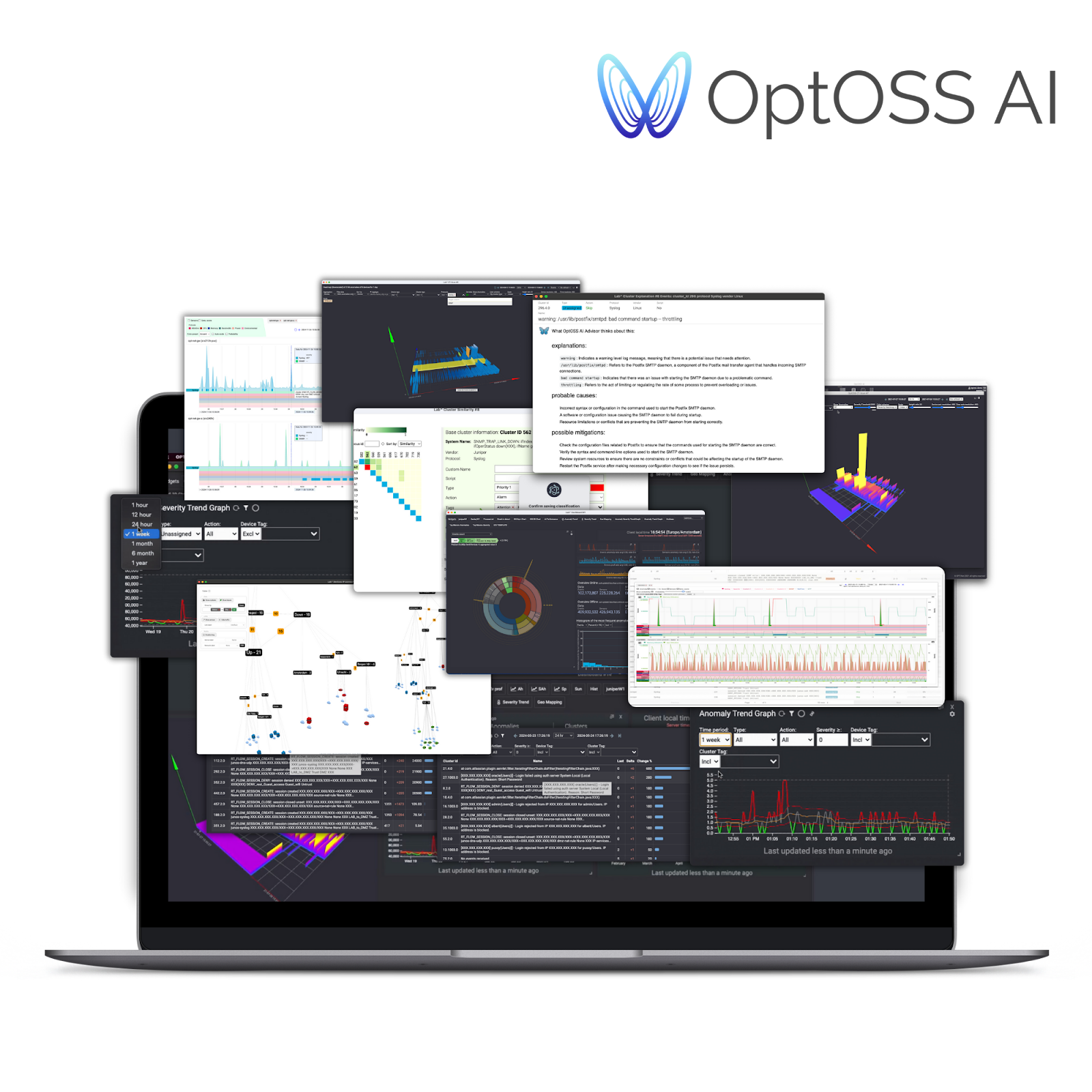
For Network Operators looking for a safe, practical, and future-proof path toward the Cognitive NOC, OPT/NET’s product OptOSS AI is an option. Unlike generic observability or analytics platforms, OptOSS AI is an AI-driven NetOps solution purpose-built for carrier-grade environments. By design, it operates at the scale and speed required for today’s networks: millions of events per second, multi-vendor complexity, and heterogeneous topologies.
OptOSS AI addresses the Cognitive NOC challenge holistically, covering all four of its essential pillars:
👉 Looking to reduce alarm volumes, cut MTTR, and move toward smarter, more autonomous network operations? Contact us for a Live Demo.
Let’s make the Cognitive NOC a reality — together!
.png)


